Rice Fields in the Casino Imagination
Rice fields in the casino imagination can feel like more than scenery. Learn how to read the design choices and separate place-setting from game symbolism.

A green terrace fills the welcome screen; gold coins spin above it, and a red glow gathers on the horizon. Rice fields in the casino imagination can turn a game’s setting into a stage for plenty, heritage and chance. The design question is not whether the image is lucky, but how its parts tell a story—and whether they belong together.
The visual brief
Imagine a small creative team planning a fictional casino-themed game with a Vietnamese-inspired landscape. Its first sketch puts a glowing pavilion above a patchwork of fields. The brief asks for a sense of abundance, but that word could mean a harvest, a full storehouse, a lush view or a screen crowded with rewards. Each choice points the artwork in a different direction.
The team starts by naming the scene’s job: establish a rural setting and create a feeling of anticipation. It does not need the landscape to explain Vietnamese farming or to make the game’s rewards seem natural. That distinction gives the designers room to build a vivid fantasy without asking the fields to carry claims they cannot support.
Composition tells the story
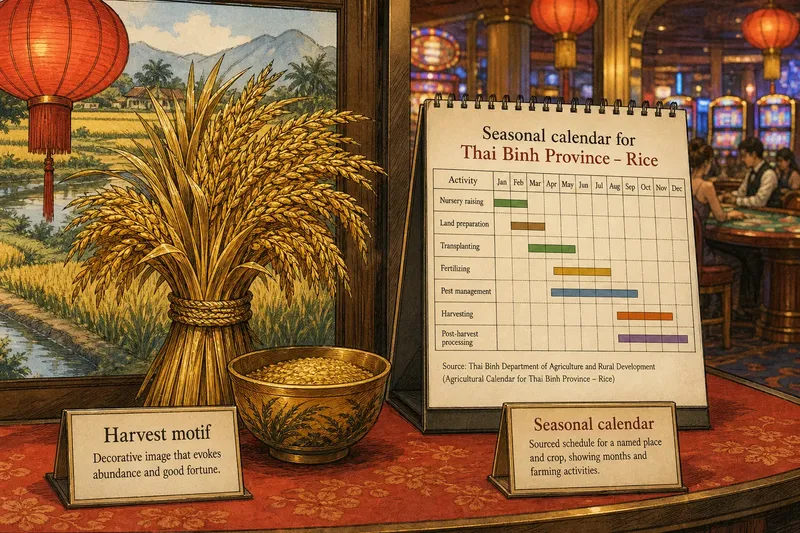
A rice field can suggest open space, cultivation or a view beyond the city. In a game scene, its meaning depends on the composition. Put a granary beside it and the image may lean towards stored food; place coins over the same field and the crop becomes a backdrop for game rewards.
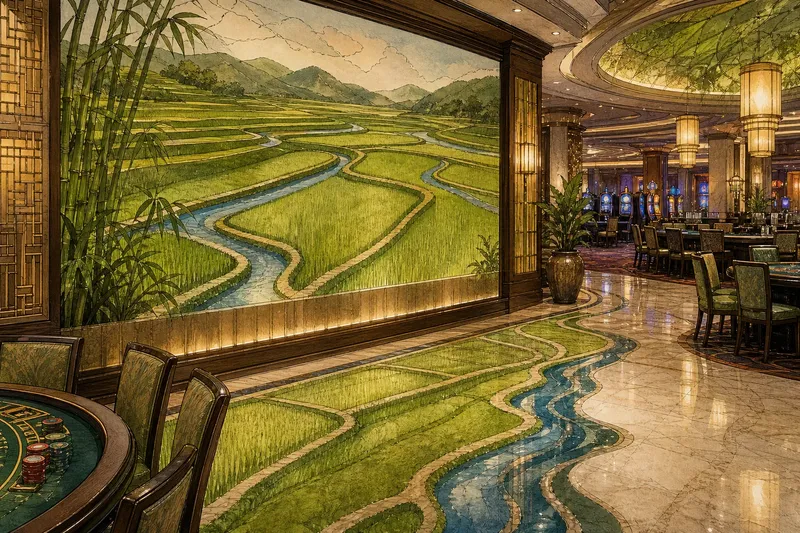
Small details also steer the eye. A bund, the raised path between plots, can give the scene a route into the landscape. Water reflecting the sky adds another visual layer. A person walking along the path may make the place feel inhabited, provided that figure has a purpose beyond serving as decoration.
Colour is part of the composition, not a farming report. Green may imply growth, while gold can recall ripening grain or echo the game’s reward effects. If gold coins and gold-toned fields merge, the design may make harvest and winnings seem like one idea. Separating those colours or placing the rewards inside the interface can clarify the intended story.
Symbols need a job
In the team’s first draft, identical terraces sit behind every screen, coin-shaped symbols sprout among the stalks, and an anonymous temple silhouette provides a vague sense of place. The image is legible as a fantasy of fortune, but its details compete: the fields appear to produce money, while the architecture signals a location without identifying one.
The team removes the coin-shaped crops and the unexplained landmark. It keeps the field, but gives it a more specific visual role: a setting with a path, water and a distant horizon. Rewards remain within the game interface, where players expect to see them. The revision shifts the scene’s energy from “the land makes wealth” to “the game tells a story against a rural backdrop”.
This is a design decision, not a claim that the revised scene depicts an actual farm. If the project names a real Vietnamese place or describes local agricultural practice, the team needs informed local input. A fictional setting should be presented as fictional rather than dressed up as documentary detail.
Reading a game scene
When you look at a rural casino backdrop, follow the visual emphasis rather than treating each element as a fixed symbol. These checks help identify what the composition invites you to notice:
- Foreground: If coins, cards or glowing rewards dominate, read the scene first as casino design; if paths, water and plots hold the eye, the landscape has more visual weight. If both compete, look for a clearer separation between interface and setting.
- People: If a resident or farmer is shown doing something that fits the scene, the landscape may feel inhabited; if the person is posed only as an ornament, consider whether the image reduces them to scenery and whether removing or reworking the figure would give the setting more dignity.
- Light: If harvest-coloured light blends into reward effects, the image may link land with winnings; if the effects stay within the game symbols, the setting and reward language remain easier to distinguish.
- Change: If weather or visible activity changes across screens, the scene may be telling a story; if the background stays still, treat it as an emblem rather than a depiction of an agricultural calendar.
- Place cues: If a named landmark or regional detail appears, check that the design has a sound basis for using it; if the team cannot identify the reference, use a clearly fictional setting instead.
- Caption: If the wording says rice or a particular landscape brings luck, revise it so the lucky association belongs to the game’s fiction; if the caption only identifies a fictional setting, keep that boundary clear.
These checks are editorial prompts, not a test of whether a scene is an authentic portrait of farm life. They help a designer decide which visual shorthand to keep, clarify or remove.
What do these images suggest?
Can a rice field suggest abundance?
Yes, a story can use a field to evoke a harvest or plenty, especially when the surrounding details support that reading. The image is an artistic choice, not evidence about the productivity of a real plot or the circumstances of rural households.
Does green scenery identify a real farm?
No. Colour alone cannot establish what is growing, how a plot is managed or where it is located. A scene meant to describe a real farm needs reliable context beyond an attractive view.
Why put a rural landscape in a casino game?
A rural backdrop can give a game a sense of distance from urban life and set a particular mood. Any connection to fortune or prosperity comes from the game’s framing and symbols, not from an inherent promise in the landscape.
How can a fictional setting feel less generic?
Give each visible detail a narrative purpose and avoid using unexplained cultural props as decoration. If the image refers to a real Vietnamese region or farming practice, seek knowledgeable local feedback; if it does not, make its fictional status plain.
A worked redesign
Say the team’s starting screen contains three elements: coin symbols among rice stalks, an unnamed temple silhouette, and a field that repeats unchanged behind every game panel. The team wants to retain a Vietnamese-inspired rural mood without implying that rice produces game rewards. It takes three actions: removes the coin symbols from the crop, replaces the silhouette with a non-specific distant horizon, and puts reward symbols inside the interface border while adding a foreground path and water to the setting.
The resulting screen has a clearer visual order: the fields establish the backdrop, the path gives the eye a route through it, and the interface holds the game’s reward language. In the pitch notes, the team replaces “rice brings luck” with “a fictional rural landscape frames a story about chance”. The trade-off is deliberate: the design gives up a quick cultural shortcut in exchange for a setting that does not pretend to document a real place.
Keep the setting distinct
When reading rice fields in the casino imagination, notice whether the design uses land to establish a place, to carry a metaphor or to blend both into one image. That question is useful for players as well as designers: it makes the visual choices easier to see without asking a landscape to validate a game’s promises.
For a project with a real Vietnamese location in mind, the next useful move is to identify the specific place and ask people with relevant local knowledge to review its portrayal. For a fictional scene, a plain description of its purpose can do the same boundary-setting work: it lets the artwork invite a mood without claiming to speak for actual farms or communities.