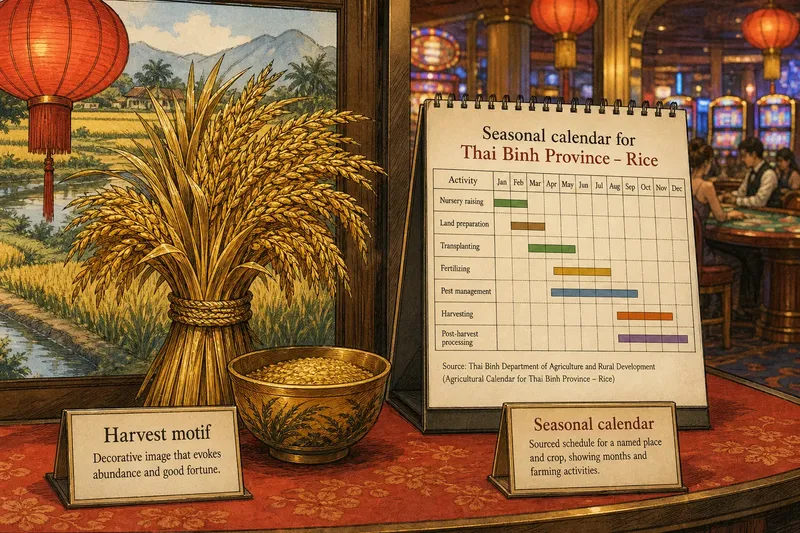
How Vietnamese Rice Landscapes Shape Casino Plant Motifs
See how Vietnamese rice landscapes inform casino plant motifs, and learn to read paddies, irrigation lines and field patterns as visual design cues.
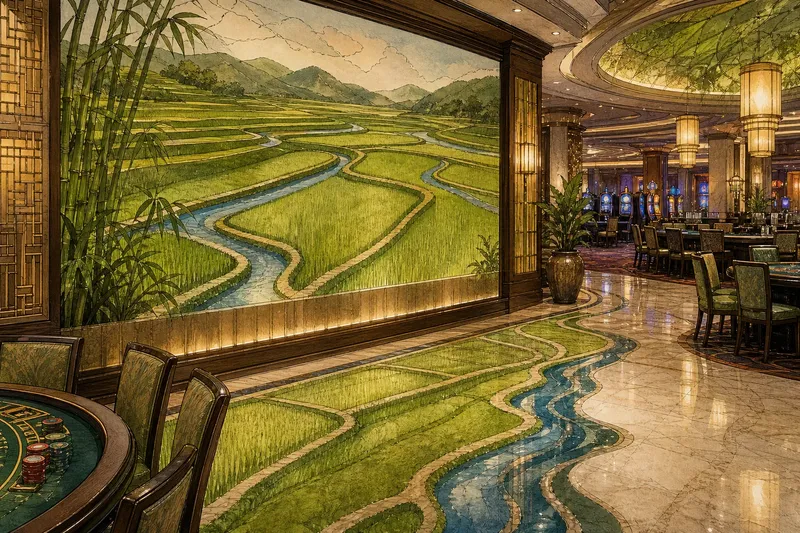
At a casino entrance, a painted rice field may run across the wall in bright green bands, with a narrow waterway threading between them. A Vietnamese rice landscape gives designers more than a harvest emblem: its patchwork, paths and changing water can shape the room’s whole visual rhythm.
Rice fields as design
Rice cultivation is closely associated with Vietnam, but fields do not all look alike. A landscape image might suggest broad, level paddies, stepped slopes or a winding irrigation channel. Each arrangement offers a different composition: level bands feel orderly, terraces lead the eye uphill, and branching water lines create movement.
Designers can translate those shapes into floor patterns, wall panels, lighting or the borders around a dining area. Woven bamboo textures and the muted greens of young rice may reinforce the reference without turning the room into a literal farm scene. The result is an interpretation, not a reliable record of any particular region or farming method.
Water and field patterns
Water is part of the visual language of a paddy landscape. A reflective strip can make a painted field seem to extend beyond the wall, while curved channels can lead visitors towards a bar or stage. In a stylised design, a blue ribbon might stand for irrigation even when it does not depict a real channel.
Look for how the parts connect. Parallel field shapes suggest division and repetition; a narrow path cutting across them gives the composition a focal line. These choices can make a room feel spacious or intimate, depending on how they are arranged, but they do not identify the landscape’s exact location.
Reading a rice landscape?
What makes a paddy-field motif recognisable?
Repeated green plots, bund-like borders and water channels often provide the visual shorthand. A single green rectangle, on its own, could suggest many things.
Do terraces represent every Vietnamese rice field?
No. Terraced slopes are one possible landscape image, while flat paddies and other field arrangements are also used in depictions of rice-growing areas. Treat the scene as a design choice unless it names a specific place.
Can a casino mural identify a farming region?
Not by appearance alone. A mural may borrow familiar shapes or colours without documenting a real location, so a regional claim needs a named place and a dependable source.
Design details to notice
Use the visible features to describe what the design actually shows, then decide how specifically to interpret it. If a detail is ambiguous, choose a broader description rather than assigning it a regional or agricultural meaning it cannot support.
- Field shape: If the plots form level bands, describe a flat paddy pattern; if they climb a slope, describe terraces, and avoid naming a region unless the artwork does.
- Water lines: If blue or reflective lines run between plots, describe channels or water-like bands; if they stop or loop decoratively, call them abstract rather than treating them as irrigation plans.
- Boundaries: If narrow raised lines divide the green areas, describe field divisions; if borders are absent, describe a continuous green composition instead.
- Pathways: If a path crosses the fields, note where it directs the eye; if no route appears, discuss the pattern without inventing a village or farm setting.
- Named location: If a label gives a place name, check a credible source before repeating a regional claim; if no place is named, keep the description general.
- Materials: If bamboo-like textures or natural colours accompany the fields, describe them as design materials; if the connection is uncertain, avoid calling them authentic local craft.
Say you enter a room with three green bands painted across a wall, two blue lines between them and no place name. Describe the bands as paddy-like plots and the blue marks as water channels suggested by the artwork. Since the lines do not connect to a labelled map or documented landscape, the sensible decision is to call the scene a stylised rice-field motif, not a portrait of a particular Vietnamese farming area.
From landscape to room
The placement of the motif changes its effect. A wide field mural behind a dining table can provide a calm backdrop, while repeated plot shapes on a corridor floor can make a passage feel longer. A small channel pattern on a screen or sign may work as a visual accent, detached from the larger landscape.
Materials also shift the mood. Glossy surfaces can make water imagery feel bright; matte greens and textured panels can give the same reference a quieter appearance. These are choices in interior design, not evidence about how rice is grown or how a particular Vietnamese community lives.
Keeping interpretations grounded
For context about a named landscape, look for a reliable source that identifies the place rather than relying on colour or shape alone. If the casino’s artwork supplies no location, describe the elements you can see: field bands, terraces, water-like lines, paths and surrounding textures. That makes the interpretation specific without pretending the room is a field guide.
When describing Vietnamese rice landscapes in casino design, distinguish the image’s composition from the agricultural place it may evoke. A careful description can still be vivid: note the slope, the divisions, the route of the water and the materials around it. The useful final detail is often the simplest one—whether the artwork shows a named place or only borrows the visual language of rice fields.