A Harvest Image or a Harvest Calendar?
A harvest image or a harvest calendar? Learn to separate casino décor from local farming schedules and label Vietnamese seasonal displays clearly.
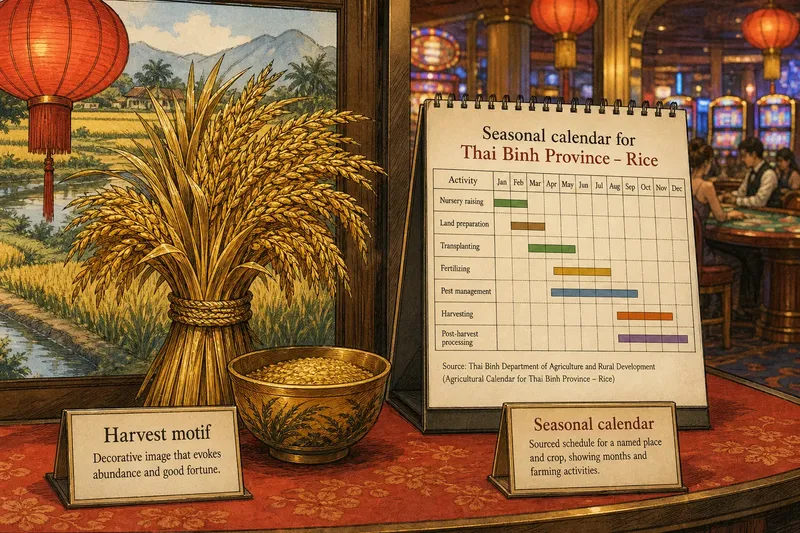
A gold sheaf hangs above a casino table, while a paper calendar beside it marks the months. A harvest image or a harvest calendar? The distinction matters when Vietnamese farming enters casino décor: one object sets a mood; the other organises information about time and place.
Rather than treating the sheaf as a shorthand for a real harvest, ask what the display actually tells you. Does it name a crop, a location or a season? If not, its role is visual storytelling, not a farming schedule. That is a more useful starting point than trying to decode agricultural facts from decorative clues.
What the image says
Start with visible details: a gold-coloured sheaf, a bowl, a red lantern, perhaps a painted field. Describe those objects before assigning them a crop or regional meaning. “Gold-coloured grain sheaf beside a bowl” sticks to what is shown; “rice harvest” makes a claim that the image may not support.
Casino décor often presents abundance as a single, polished moment. A sheaf looks gathered; a full bowl looks ready to serve. The scene leaves out the work and changing conditions behind a crop, because its job is to create an atmosphere, not document a farm’s activities.
That visual shorthand can still be interesting. It may invite questions about harvest, food or good fortune, but the answers need a source beyond the decoration. Treat the motif as a prompt for conversation rather than a calendar in disguise.
How calendars differ
A calendar gives time an order. It may connect months or locally used dates to activities, and it needs a defined scope: a place, a crop, or both. Without that context, a neat row of seasons can look more universal than it is.
For a display about Vietnamese agriculture, avoid presenting one generic calendar as the schedule for the whole country. Conditions and practices can vary by area and crop. Keep the calendar’s source and stated coverage visible, and describe any limits plainly.
A simple caption can do much of the work: “Harvest motif” identifies the decorative object, while “seasonal calendar for [named place or crop]” tells visitors what the schedule covers. The labels prevent a symbolic picture from appearing to verify agricultural dates.
Making a local display
Before adding dates, decide what the display is meant to explain: a school discussion, a farm visit, a food event or a general introduction to seasonal timing. Then choose a locally relevant source for the place and crop in question. Keep the motif and the schedule as separate objects, with separate captions.
Check each detail and let the result guide what you include:
- Place: Check whether the source names an area. If it does, include that area in the caption; if it does not, leave the calendar broad and do not imply local coverage.
- Crop: Check whether the source identifies a crop. If it does, name it; if it does not, describe the calendar as general rather than assigning it to rice or another crop.
- Time markers: Check whether the source gives months, seasons or locally used dates. If it does, reproduce those markers with their context; if it does not, do not invent a timeline.
- Activities: Check which tasks the source links to its time markers. If it names activities, include only those; if it does not, avoid adding planting or harvesting tasks from guesswork.
- Source: Check that the calendar’s source can be identified. If it can, show the source alongside the display; if it cannot, present the material as an illustrative graphic, not a factual schedule.
- Caption: Check whether the label distinguishes image from schedule. If it does, keep it; if it blurs them, replace it with separate labels for the motif and calendar.
Say you are preparing a casino-themed event display. Your starting materials are a gold sheaf beside a bowl and a calendar source that names a particular Vietnamese area and crop, with months and tasks. First, caption the sheaf “Harvest motif” because the decoration gives no location or dates. Next, copy only the source’s stated area, crop, months and activities onto a separate calendar panel, and identify the source. The result is two clear claims: the sheaf evokes abundance, while the panel presents a schedule within its stated scope. If the source had no named area or crop, the trade-off would be a less specific panel rather than a falsely local one.
Reading the display?
Can a harvest image show the harvest season?
It can suggest a harvest theme, but the image alone cannot establish when or where a crop is gathered. Use a locally relevant source for dates and describe the picture as a motif.
Why does casino décor make harvest feel timeless?
Decorative scenes are designed to work as atmosphere whenever they are displayed. A calendar, by contrast, depends on an ordered sequence and a defined context.
Can one calendar represent all of Vietnam?
Do not assume that one schedule covers every place and crop. Check its stated area and subject, and limit the caption to that scope.
Keep labels distinct
When the two objects appear side by side, make the difference visible in their names. “Harvest motif” signals an image; “seasonal calendar for [named place or crop]” signals a schedule with a stated scope. A short note can add that the decoration evokes abundance while the calendar organises agricultural time.
Use the phrase harvest image or harvest calendar as a practical test: does the object create a scene, or does it give a sourced sequence tied to a place and crop? That distinction lets Vietnamese agricultural imagery carry atmosphere without being mistaken for a farming record. If a visitor asks about the season, point to the calendar’s source and scope—not to the gold paint.